
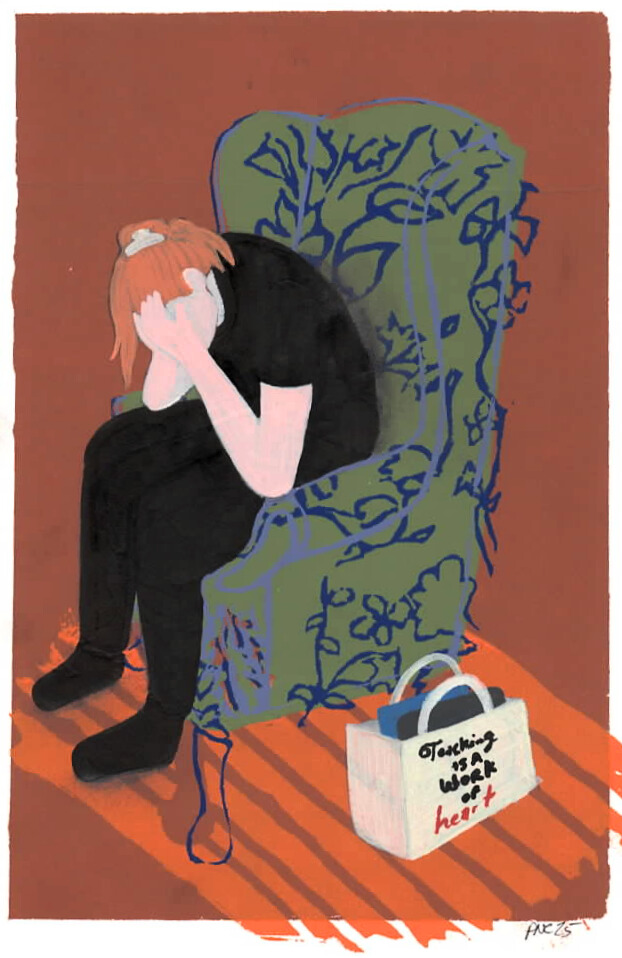

Why Art Teachers Leave: What My Capstone Research Found About Working Conditions and Burnout
In September 2022, I left the classroom. In five years of teaching, I had never imagined doing it. But my class sizes had ballooned, my pay was stagnant, and I no longer felt able to do the job I loved. For a year, I worked outside of education entirely, and when I returned to teaching in 2023, I turned the experience into my capstone project for my Master of Arts in Art Education at the University of Florida. Now I have left the classroom again, but continue to work in Art Education and spread awareness of the many struggles that plague the field.
Why this research matters
Research on the working conditions of art teachers is scarce, and most states don’t track teacher shortages by subject. Yet the pipeline is shrinking: from 2012 to 2019, the number of students pursuing art education degrees fell by 40%. Many states have responded with alternative certification routes, a quick fix that has been linked to high attrition. Without understanding why art teachers leave, we can’t keep them.
How I studied it
I used arts-informed narrative inquiry, drawing on two kinds of data. The first was my own journals from my last year in my previous district, which I reviewed after leaving. The second was daily journaling combined with hand-drawn maps of my movements through the school day, which I kept for two weeks at my new school. The maps helped me recall details and emotions I would otherwise have forgotten. The research took place at two Title I public schools in two South Louisiana districts.
What I found
Three themes emerged from the journals and maps.
Deprofessionalization. I lost control over my curriculum, classroom management, and even which campus I worked at. Art was treated as less important than core subjects, with planning periods interrupted, classes used for testing or photos, and unpaid extra projects expected of me as “the artist.” Recognition and promotion never matched the workload.
Working conditions. Both schools involved constant sink repairs, too little storage, and a large amount of time spent sourcing supplies. My maps showed how much of a school day goes to gathering materials and modeling techniques, and how isolated an art classroom can be, in one case as the only classroom on a balcony.
Work/life balance. I managed six different preps and over 180 students while taking on district projects with no extra pay. Class sizes of nearly 40 drained my physical and emotional energy in a way that 20 students did not. In my journals, the joy of teaching gave way to exhaustion.
What needs to change
My recommendations are practical and fixable:
- Keep class sizes small enough for individualized instruction
- Treat art teachers as professionals, and offer curriculum support without rigid mandates
- Pay for after-school commitments like art shows and extracurriculars
- Protect planning time and instructional time
- Create paths for advancement, and offer financial aid for advanced degrees regardless of subject
- Educate parents, policymakers, and communities about the value of arts education
A note on limits
This is one teacher’s story in two districts, so it can’t speak for every art teacher. But personal narrative has value. Stories can show decision-makers what data alone can’t, and I hope mine helps other art teachers feel less alone.